
Author: Natxielly J. Castaneda P.
Cuando llamo a mi Infinitud, puedo ir a través de cualquier cosa.
Entonces nunca estaré inválido.
Esa es la regla de la vida.
octubre 21, 2022 | YogiBhajan
SUMMARY
This study aimed to evaluate the impact of gong sound therapy on participants’ well-being, with a primary focus on alleviating stress and relieving physical and emotional discomfort. Participants completed a questionnaire both before and after each sound therapy session, providing information on various aspects such as physical energy, pain intensity, feelings of illness, sadness, stress, and anxiety. The study involved adults aged between 29 and 53, with a majority being women.
The results indicated a significant reduction in stress, anxiety, physical pain, and sadness following the Gong sound therapy sessions. Notable improvements were observed, especially in the areas of stress and anxiety. The study concludes that gong therapy can be an effective method for enhancing emotional and physical well-being in adults. Furthermore, it underscores the need for further research with larger sample sizes and longitudinal studies to solidify the scientific foundation for these positive outcomes, highlighting the importance of expanding knowledge in this field.
Keywords: Gong, stress, anxiety, sound therapy, emotional well-being.
ABSTRACT
Este estudio tuvo como objetivo evaluar el impacto de la terapia de sonido con gong en el bienestar de los participantes, centrándose principalmente en aliviar el estrés y el malestar físico y emocional. Los participantes completaron un cuestionario antes y después de cada sesión de terapia de sonido, que incluía información sobre diversos aspectos como la energía física, la intensidad del dolor, la sensación de enfermedad, la tristeza, el estrés y la ansiedad. El estudio incluyó a adultos de entre 29 y 53 años, la mayoría mujeres.
Los resultados indicaron una reducción significativa del estrés, la ansiedad, el dolor físico y la tristeza tras las sesiones de terapia de sonido con gong. Se observaron mejoras notables, especialmente en el estrés y la ansiedad. El estudio concluye que la terapia de sonido con gong puede ser un método eficaz para mejorar el bienestar emocional y físico en adultos. Además, destaca la urgente necesidad de realizar más investigaciones con muestras más grandes y estudios longitudinales para fortalecer la base científica de estos resultados positivos, destacando la importancia de ampliar el conocimiento en este campo.
Palabras clave: Gong, estrés, ansiedad, terapia de sonido, bienestar emocional.
INTRODUCTION
Today, stress is one of the leading causes of both emotional and physical discomfort. Stress affects nearly every system in the body, both physically and emotionally. When people experience stress, the body triggers the «fight or flight» response, releasing hormones such as cortisol and adrenaline. While short-term stress can enhance the ability to respond quickly to threats, chronic stress, also known as «long-term stress,» can have detrimental effects on various organs and bodily functions. The fast-paced lifestyle, excessive workloads, and social demands create constant pressure that negatively affects people’s overall well-being and health.
The University of Texas Health Science Center at Houston reported in a 2025 study. Recent research indicates concerning levels of high stress and high mental health conditions in Fort Bend County. The research reveals that many adults experience a significant number of days when their mental health is not at its best. It gives us a general picture of how often people struggle with their mental well-being each month.
- Adults aged 18–29 report approximately 6 days per month of poor mental health.
- Adults aged 30–54 report about 4.1 days of poor mental health.
- Adults aged 55 and older experience around 2.6 days of poor mental health.
The report also identified a serious gap in access to mental health services. Half of the county’s residents said they had needed mental health care in the past 12 months, but less than half (49%) said they could always access it. About 1 in 8 residents (13%) reported a poor/fair mental health status overall.
According to the WalletHub study for the 2025 United States report, Texas has ranked as the 14th most stressed state in the nation. This ranking is based on a comprehensive analysis of 40 different indicators that reflect the various pressures faced by residents. It is essential to recognize that many individuals and families encounter significant challenges in achieving a work-life balance, managing family responsibilities, addressing health concerns, and maintaining financial stability. Each of these factors can create a significant burden, contributing to the stress that many are experiencing throughout the state. Understanding and addressing these issues is crucial as we work towards supporting one another through difficult times.
The research provides a comprehensive overview of highly related stress categories, ranked by area in the United States, with a specific focus on Texas.
- Work-related stress ranks 11th (Texas has the second-longest workweek in the country).
- Family stress ranks 8th.
- Health and safety stress ranks 9th.
- Financial stress ranks 23rd.
The Gong, an ancient instrument, has a unique ability to transform emotional states through its sound frequencies and vibrations. Its therapeutic use provides promising benefits for emotional regulation, stress reduction, and the enhancement of overall physical and emotional well-being, making it a valuable approach for stress relief and offering hope for those seeking a non-invasive technique.
Gong sound therapy is based on the principle of resonance, which is thought to promote a calming and relaxing effect. Previous studies suggest that sound sessions featuring instruments like gongs can soothe the mind and relax the body, potentially aiding in stress management by lowering heart rates and enhancing overall well-being (Goldsby et al.,2017). The use of gong vibrations in sound therapy has become increasingly popular, thanks to its reported beneficial effects on the nervous system and stress regulation. Research conducted by Vikrampal Singh (2023), Ulices Verduzco (2025), and Francisco Xavier Rosero Menéndez (2025) has demonstrated that gong therapy can enhance emotional well-being, alleviate insomnia, and mitigate general malaise in cancer patients, as well as in individuals experiencing high levels of stress and anxiety. These findings indicate that gong therapy may serve as a complementary, non-invasive tool that positively impacts both physical and emotional health.
While gong sound therapy has shown promise in alleviating stress, particularly in high-stress scenarios, there is a notable lack of solid scientific evidence regarding its effectiveness. Much of the current research relies on personal anecdotes or involves small participant groups, making it challenging to draw firm conclusions. To more accurately evaluate its potential benefits, well-structured studies are necessary to determine its effectiveness as a means of enhancing workplace health. This underscores the need for further research in this field and the potential for future advancements.
This research specifically focuses on the effects of gong sound therapy on the stress levels of adults who encounter high-pressure situations in their daily lives. The primary objective is to determine whether this therapy can help alleviate stress by assessing participants’ physical and emotional health before and after the therapy sessions. Four individuals, primarily women aged 29 to 53, took Part in four weekly gong sound therapy sessions over a month. Data was gathered through a survey, and the results were analyzed using basic statistical methods.
General Objective
This study investigates the effectiveness of gong sound therapy in enhancing mental health. It specifically investigates the impact of Gong sounds on reducing stress and alleviating emotional challenges among four participants involved in the research. The findings of this study make a significant contribution to the understanding of alternative therapeutic interventions in mental well-being, shedding light on the potential of gong sound therapy.
Specific Objectives
- Aim to describe the physical and emotional states of four participants before the gong sound therapy.
- Analyze changes in stress, anxiety, and sadness levels after gong sound therapy.
- Compare results from before and after the intervention with gong sound therapy.
- Identify patterns of improvement in participants’ physical and emotional well-being.
THEORETICAL FRAMEWORK
The World Health Organization acknowledges that individuals respond to stressful situations in various ways, with coping styles and stress symptoms differing from person to person. They highlight that stress impacts both mental and physical health. While a small amount of stress can be beneficial and enhance our daily performance, excessive stress can lead to significant health issues. Therefore, they recommend learning effective coping strategies to help manage stress, ultimately promoting our overall mental and physical well-being. (The World Health Organization, Feb. 2023)
The Mayo Clinic of Health emphasizes the importance of managing stress in our lives. Rather than passively allowing stress to overwhelm us, discovering enjoyable and engaging ways to cope can be very beneficial. (Mayo Clinic of Health ART-20050987)
The Mayo Health Clinic also provides tips to help lower your stress levels.
- Engage in relaxing activities such as deep breathing exercises, meditation, yoga, tai chi, or treat yourself to a soothing massage.
- Spend quality time with family and friends to strengthen your support network.
- Listen to your favorite music or take a leisurely walk to lift your spirits.
- Ensure you get enough sleep each night to help your body and mind recharge.
- Maintain a healthy, balanced diet to fuel your body properly.
The Mental Health CDC acknowledges that everyone experiences stress at some point; it is a natural response to new or challenging situations. Stress can arise in various aspects of life, including work, school, health, and relationships. While feeling stressed is a normal reaction to problems, especially during short bursts, chronic stress that lasts for an extended period can lead to serious health issues.
The CDC provides many options. If you or someone you know is struggling or in crisis, confidential, free, 24/7/365 help is available. Call or text 988 or chat 988lifeline.org.
The CDC recommends practicing gratitude as a powerful tool for reducing stress and improving both physical and emotional health. To help calm your mind, try taking deep breaths, stretching, or meditating. Keeping a journal can also be beneficial for expressing your thoughts and feelings. (The Mental Health (CDC) Managing Stress June 2025)
Sound healing, often referred to as a «sound bath,» is a practice that utilizes unique musical instruments, such as singing bowls and gongs, to create soothing sounds. The term «sound bath» refers to the enjoyable sensation people experience when surrounded by these calming sounds and vibrations, resulting in a deep sense of relaxation and tranquility. This approach combines elements of music therapy with meditation. Although it may not yet be mainstream, its popularity has been steadily increasing in recent years. The history of gongs is both fascinating and rich, particularly in various Eastern cultures across Asia, where they have held a significant role in ceremonies, spiritual practices, and healing traditions for centuries. In recent years, an increasing number of individuals have turned to gongs sound therapy, drawn by their capacity to produce deep, resonant sounds that promote relaxation and emotional healing.
Research conducted by the Instituto Internacional Terapia de Sonido (IITS) has thoroughly examined the non-invasive benefits of gong sound therapy in stress management. The findings highlight the healing potential of sound frequencies and resonance in promoting relaxation and mitigating physiological stress responses. According to the IITS, the vibrations produced by gongs resonate within us, helping to clear our minds and guide us toward a state of tranquility, physically and mentally.(iterapiadesonido.es/tesis)
The Instituto Internacional Terapia De Sonido(IITS) recent study examined the effects of Gong sound therapy on emotions such as stress, sadness, pain, and anxiety. Conducted during the Wesak Moon festivities in 2023, the research involved 363 participants across 42 sound bath therapy rooms in 6 different countries. Following the methods of Gong Master Don Conreaux, participants reported significant improvements: Pain levels decreased by 37%, sadness declined by 65%, stress dropped by 66%, and anxiety reduced by 67%. This study highlights the numerous benefits for both mental and physical well-being, emphasizing the positive impact on overall health. (Vikrampal Singh, vikrampal.es/luna-wesak-2023)
A study conducted by Ulices Verdusco (2025), titled TERAPIA DE SONIDO CON GONG EN EL ALIVIO DE LOS SINTOMAS DE LA ALTA CARGA LABORAL «Gong Sound Therapy for Alleviating Symptoms of a Heavy Workload, offers valuable insights into the benefits of Gong sound therapy on stress management. This research was conducted in the United States, specifically in New York, with a focus on the fast-paced environment of the restaurant industry. The findings indicate a remarkable 82% improvement in overall stress levels,67% reduction in anxiety, and 62% decrease in pain levels. These results suggest that Gong sound therapy can significantly enhance both physical and emotional well-being after just one session.(iiterapiadesonido.es/terapia-de-sonido-con-gong-en-el-alivio-de-los-sintomas-de-la-alta-carga-laboral)
Francisco Xavier Rosero Menéndez (2025) conducted a research study at the Instituto Internacional Terapia de Sonido (ITTS) titled IMPACTO DE TERAPIA DE SONIDO CON GONG SOBRE EL CORTISOL COMO HORMONA DEL ESTRÉS. «Impact of Gong Sound Therapy on Cortisol as a Stress Hormone.» This study involved 25 participants, predominantly men, who reported notable reductions in stress (80.2%), pain (89%), and anxiety vanished completely. Additionally, cortisol levels were measured throughout the study. The average cortisol level during the admission phase was 13.11, which was slightly higher than the level observed during the discharge phase at 12.86; however, this difference was not statistically significant (p > 0.05).
(iiterapiadesonido.es/impacto-de-terapia-de-sonido-con-gong-sobre-el-cortisol-como-hormona-del-estres)
In summary, gongs are considered powerful instruments capable of creating beautiful music. Sound therapy that incorporates gongs utilizes rhythm and vibration to aid in healing both the body and mind, making it an excellent choice for anyone seeking balance and calm in their life.
There are various theories about how sound healing influences our well-being. These concepts encompass how various types of sound can impact our brains and overall health. For instance, specific sound frequencies can promote different levels of relaxation. When we engage in music therapy or sound healing, our brainwaves may shift, which significantly contributes to the calming effects we experience.
The commonly discussed brainwave states in scholarly literature include those presented by (Ann and Bae (2017), Hassan et al. (2012), and Hohashi et al. (2004).
- Gamma: over 30 Hz: the fastest brainwave. Processing of information from different brain areas.
- Beta: 12–30 Hz: alert consciousness, concentration, focus, or anxiety.
- Alpha: 8–12 Hz: relaxed, lucid, calm, peaceful.
- Theta: 4–8 Hz: light sleep, meditation, or deep relaxation.
- Delta: Less than 4 Hz: deep, dreamless sleep or deep state of meditation.
The sound of gongs can create deep, multi-layered frequencies that interact with both the body and the mind, promoting relaxation and balance. Here are the main benefits of gong sound therapy for the nervous system:
- Activates the parasympathetic nervous system, calming the body and reducing stress.
- Lowers cortisol levels, which can improve mood and decrease anxiety.
- Facilitates brainwave entrainment, promoting relaxation and enhancing creativity.
- Reduces sympathetic overdrive, thereby decreasing the fight-or-flight response.
- Stimulates the vagus nerve, which enhances emotional resilience.
- Improves sleep quality, restores energy, and boosts cognitive focus.
Don Conreaux recommends that a Gong Puja typically lasts around 7 1/2 hours, which is equivalent to ten 45-minute Gong Sound Baths. A Gong Puja is a devotional ritual that honors and creates space for participants to heal in mind, body, and spirit. The Gong serves as both the object and instrument that facilitates self-healing. In his book «Magnum Opus of The Gong Theory,» Don Conreaux articulates his Gong Philosophy: the Gong acts as an engine of power, releasing tonal resonance and complex harmonics that are transmitted to the recipient.
Vikrampal Singh is an expert in using gongs for healing and personal growth, drawing inspiration from the traditions of Kundalini Yoga. Instead of playing music for entertainment, he uses the Gong as a powerful tool for deep relaxation and transformation. Vikrampal believes that the sounds produced by the Gong can penetrate deeply into our bodies, helping to release stress and remove blockages in our energy flow.
The vibrations of the Gong can influence our brainwaves, encouraging a state of calm that facilitates meditation. In his practice, he connects the sound of the Gong with the concept that our bodies have energy centers known as chakras. He teaches that the Gong can help balance these energy centers and promote a smoother flow of energy throughout the body, particularly along the spine. Overall, Vikrampal’s approach offers a holistic method for enhancing well-being through sound therapy.
LEGAL FRAMEWORK (TEXAS, UNITED STATES )
- Texas lacks specific workplace stress regulations.
- Although there are no federal standards that directly address stress in the workplace, it is recognized as a significant risk.
- OSHA reports that 83% of American workers face work-related stress, contributing to about 120,000 deaths annually.
- The ADA prohibits discrimination against employees with anxiety or depression and mandates reasonable accommodations for stress-related disabilities.
METHODOLOGY
We conducted a comprehensive quantitative, descriptive, and longitudinal study to investigate the impact of gong sound therapy on participants’ stress levels. Utilizing a Likert-type scale, specifically the VIKRAMPAL GONG BENEFITS QUESTIONNAIRE V22-01, we measured participants’ perceived stress before and after each gong therapy session.
This measurement tool is widely recognized in research for its effectiveness in capturing subjective experiences. Participants rated their stress levels based on a series of statements, with responses ranging from 0, reflecting no stress at all, to 5, which indicated a high level of stress. This structured approach allowed us to assess fluctuations in stress in a detailed and nuanced manner throughout the therapy sessions.
We opted for a quantitative approach in our study, which involved collecting and analyzing data through a questionnaire. Participants rated their feelings about stress on a scale, allowing us to describe how individuals experienced and perceived stress in their lives. Additionally, our study was conducted over an extended period, during which we collected information at various times.
This approach enabled us to observe how participants’ experiences with stress changed and developed throughout their therapy journey.
Four adult women, aged between 29 and 53, participated in the study voluntarily. They experienced high levels of stress due to their daily work. They provide a digital questionnaire before and after the gong sound therapy. The confidentiality of each participant was guaranteed in accordance with HIPAA (the federal Health Insurance Portability and Accountability Act)
The Gong sound therapy study took place in the United States between May and July 2025. The choice of the United States as the study setting was based on the availability of suitable research facilities and the prevalence of stress-related issues in the population. The Gong sound therapy took place at a holistic relaxation center, chosen for its peaceful and conducive environment. Each participant arrived individually, ensuring a personalized and focused experience, and adjusting to the different available hours. Once a week, with a total of four Gong Sound Therapy sessions per person.
The majority are women between the ages of 29 and 53.
May 31, 2025
June 14- 28, 2025
July 5, 2025
A quantitative, descriptive, and longitudinal study was conducted using a Likert-type scale (VIKRAMPAL GONG BENEFITS QUESTIONNAIRE V22-01) to analyze participants’ stress levels before and after each Gong sound therapy session.
The Likert-type questionnaire ranged from 0 to 5 points and covered six variables:
- Energy
- Pain
- Feeling sick
- Sadness
- Stress
- Anxiety
The forms were completed by each participant digitally before and after the therapy. Confidentiality was guaranteed in accordance with the U.S. Health Insurance Portability and Accountability Act of 1996 (HIPAA)
In every Gong Sound Bath therapy session, we use the same instruments and maintain a duration of 60 minutes. In each gong sound bath therapy session, the following list of instruments is implemented in the same sequence:
First Part of the Gong Sound Therapy:
• 5 minutes of a breathing exercises to help relax the body.
• 5 minutes of Meinl Sonic Energy crystal singing bowl (heart chakra) F 432Hz
Second Part of the Gong Sound Therapy:
• 45 minutes of Paiste 30″ F1 45.4 Hz symphonic Gong
Third Part of the Gong Sound Therapy:
• 5 minutes of Koshie chimes Element (Earth)
The participant was allowed to return to a calm and silent state, with conscious awareness.
Participants completed the questionnaire anonymously in an electronic format. Before participating, they signed an informed consent form that ensured data confidentiality and voluntary participation.
The confidentiality of all data was maintained throughout the study period, and any potential publication adhered to the U.S. Health Insurance Portability and Accountability Act of 1996 (HIPAA), the Protection of Personal Data, and the Guarantee of Digital Rights.
The questionnaires were administered at both the beginning and end of the project to gather information on user perceptions, expectations, and satisfaction. A quantitative, descriptive, and longitudinal study design was employed, using Excel to calculate differences and graphically represent the data. Each change was digitally recorded for each participant before and after the gong sound therapy.
The software used for the study included Google Forms and Microsoft Excel.
RESULTS
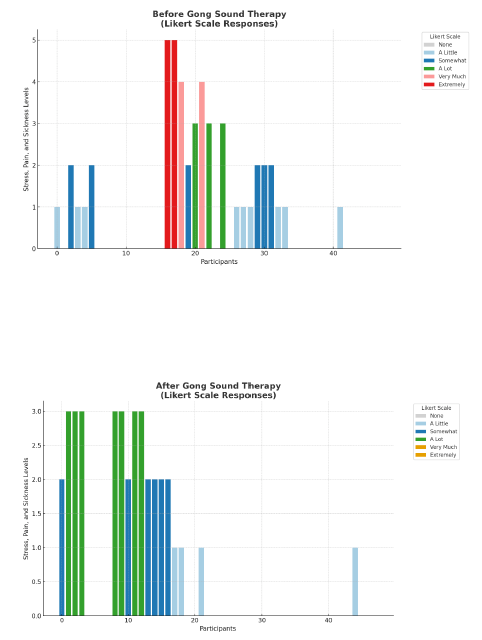
The results obtained from the application of Likert-type scales before and after gong sound therapy indicate notable and variable improvements in both physical and emotional states among the four participants, ranging in age from 29 to 53
Physical Energy – There was a slight average improvement in reported energy levels following therapy. Participants who initially rated their energy between «a little» and «somewhat» (2.5) reported slightly higher averages after the intervention (3.0). Majory reported feeling sleepy.
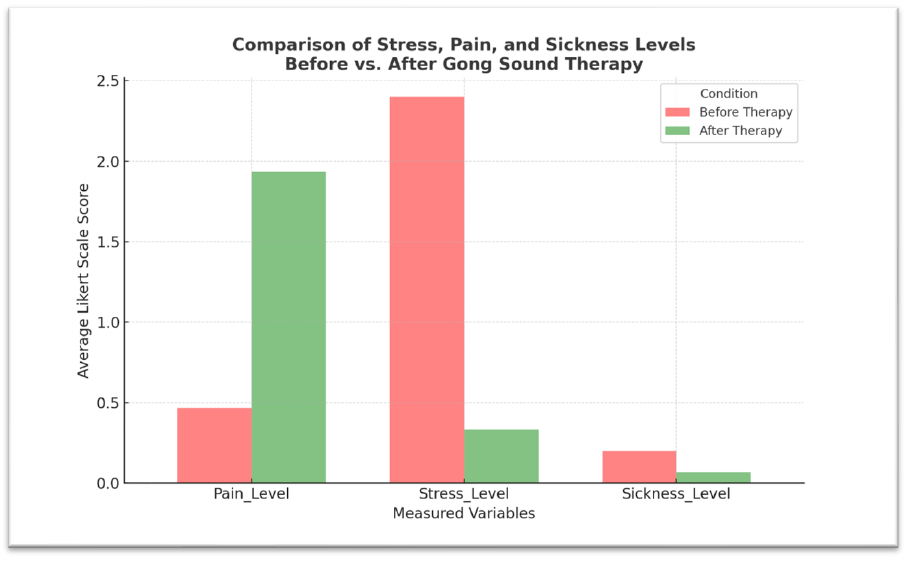
Pain Levels: A consistent reduction in perceived pain was observed. Before therapy, several participants reported moderate to high levels of pain (2.0 on average), which dropped to approximately 1.0, indicating minor or no discomfort for most subjects.
Emotional State – Stress Levels: The therapy resulted in a significant decrease in stress levels. Average pre-session stress scores (approximately 4.0) decreased sharply to approximately 1.5 after therapy. In several cases, participants who initially reported extreme stress (4 on the Likert scale) rated their stress as zero after the session.
Anxiety Levels: Anxiety also showed an apparent reduction. Pre-session averages around 3.0 dropped to approximately 1.0 after therapy, reflecting greater emotional calmness and stability overall.
The comparative analysis between pre- and post-intervention scores demonstrates that gong sound therapy effectively supports stress relief, pain reduction, and emotional regulation. These findings are consistent with the hypothesis that sound-based relaxation techniques can influence the autonomic nervous system, promoting deep relaxation and improved well-being.
DISCUSSION
The results obtained from the application of Likert-type scales before and after gong sound therapy indicate notable and variable improvements in both physical and emotional states among the four participants, whose ages ranged from 29 to 53.
Physical Energy: There was a slight average improvement in reported energy levels after the therapy. Participants who initially rated their energy between “a little” and “somewhat” (approximately 2.5) reported slightly higher averages after the intervention (approximately 3.0). One participant, Majory, reported feeling sleepy.
Pain Levels: A consistent reduction in perceived pain was observed. Before therapy, several participants reported moderate to high levels of pain (approximately 2.0 on average), which dropped to around 1.0 afterward, indicating minor or no discomfort for most subjects.
Emotional State: Stress Levels – The therapy led to a significant decrease in stress levels. Average pre-session stress scores (approximately 4.0) decreased sharply to around 1.5 after the therapy. In several cases, participants who initially reported extreme stress (4 on the Likert scale) rated their stress as zero after the session.
Anxiety Levels: Anxiety also showed a notable reduction. Pre-session averages of around 3.0 dropped to approximately 1.0 after the therapy, reflecting greater emotional calmness and stability.
Overall Impact: The comparative analysis between pre- and post-intervention scores demonstrates that gong sound therapy effectively supports stress relief, pain reduction, and emotional regulation. These findings support the hypothesis that sound-based relaxation techniques can influence the autonomic nervous system, promoting deep relaxation and enhanced well-being.
CONCLUSIONES
The study validates the hypothesis that gong sound therapy has a positive impact on both physical and emotional well-being. This effect is likely attributable to its influence on the autonomic nervous system and neuroendocrine responses. These findings contribute to the growing body of evidence that endorses sound-based therapies as non-invasive, accessible, and practical approaches for alleviating stress and enhancing overall well-being.
Future research could focus on replicating this study in various educational settings to understand how different environments affect study habits. Additionally, conducting longitudinal analyses would offer valuable insights into how these habits evolve over the course of an academic career. This would provide a deeper understanding of the factors that contribute to academic success and persistence over time.
REFERENCE
Patel, A., Lu, J., Bitra, J., Dommaraju, S., Loizzo, D., Guillen, B., … & Fokuo, K. (2025). Lifestyle behaviors and mental health of health professional students during COVID-19, as measured by the CDC’s BRFSS, for the HOLISTIC cohort study. PLOS Mental Health, 2(4), e0000302.
Seshadri, A., Fuller-Tyszkiewicz, M., Harper, L., Clark, M. M., Singh, B., Chesak, S., … & Frye, M. A. (2025). Randomized controlled trial of stress management and resiliency training for depression (SMART-D)-pilot study. PloS one, 20(8), e0328539.
Mayo, L. M., Gauffin, E., Petrie, G. N., Tansey, R., Mazurka, R., Haggarty, C. J., … & Heilig, M. (2025). The efficacy of elevating anandamide via inhibition of fatty acid amide hydrolase (FAAH) combined with internet-delivered cognitive behavioral therapy in the treatment of post-traumatic stress disorder: a randomized, placebo-controlled clinical trial. Neuropsychopharmacology, 1–9.
Goldsby, T. L., Goldsby, M. E., McWalters, M., & Mills, P. J. (2017). Effects of singing bowl sound meditation on mood, tension, and well-being: an observational study. Journal of evidence-based complementary & alternative medicine, 22(3), 401-406.
Shing, F. J. S. K. H., & Shing, F. J. S. K. H. Los efectos de la Terapia del Sonido en el Tratamiento de Cáncer de Peritoneo.
Gong Sound Bath Therapy Set-up from May-July 2025
